
The Associate of Science in Radiologic Technology program is designed to provide students with comprehensive knowledge and practical skills necessary to pursue a career in the field of radiologic technology. This program prepares individuals to become competent and professional radiologic technologists who can perform diagnostic imaging procedures with precision and compassion.
Throughout the program, students will gain a strong foundation in medical sciences, radiation physics, and imaging techniques. They will learn to operate sophisticated imaging equipment. Emphasis is placed on developing critical thinking skills, problem-solving abilities, and effective communication with patients, physicians, and other healthcare professionals.
The curriculum covers a wide range of subjects, including anatomy, physiology, patient care, radiation safety, image analysis, and radiographic positioning. Students will learn to assess patient needs, position them correctly, and apply appropriate radiation protection measures. They will also acquire knowledge to take diagnostic images that will be used by doctors and radiologists for interpretation.
Hands-on clinical experience is a vital component of the program, allowing students to apply their theoretical knowledge in real-world healthcare settings. Under the supervision of experienced radiologic technologists, students will engage in clinical rotations in hospitals, medical clinics, and imaging centers. These clinical experiences provide an opportunity for students to refine their technical skills, develop professional ethics, and gain exposure to various specialties within radiologic technology. See if there is an existing externship site in your local area. (**Exact externship locations are based on site availability, not distance. Students often have to commute or travel to sites outside of their local area.**)
The Radiologic Technology Associate of Science degree prepares students to become an entry-level professional in radiography. Students will:
Upon successful completion of the program, graduates will be eligible to take the national certification examination offered by the American Registry of Radiologic Technologists (ARRT)(R). Certification is a requirement for employment in most healthcare facilities and ensures that graduates meet the standard of competence and professionalism in the field.
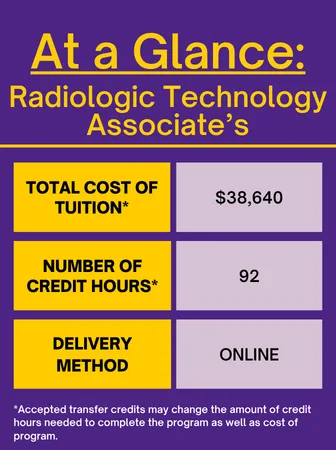
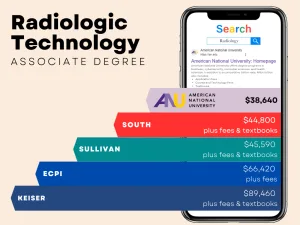 Total tuition for an associate’s degree in Radiologic Technology at ANU is only $38,640. Large online colleges with course-based programs are 16% – 131% higher and do not include fees or textbooks.(1) ANU tuition includes all fees (application, course, technology, graduation, etc.), textbooks, and lab equipment (where applicable).
92 credit hours required. All courses are 4 credit hours
Program Core Courses
60 Credit Hours
RTA101 Introduction to Medical Imaging and Radiologic Sciences and Healthcare
RTA103 Ethics and Law in Medical Imaging and Radiologic Sciences
RTA105 Safety and Protective Practices
RTA111 Radiographic Procedures I
RTA113 Radiographic Procedures II
RTA201 Radiation Physics and Instrumentation
RTA204 Image Production and Analysis
RTA205 Radiation Biology and Health Physics
RTA211 Radiographic Procedures III
RTA213 Radiographic Procedures IV
RTA221 Clinical Practice
RTA298 Radiologic Technology Certification Exam Review
RTA299A Radiologic Technology Externship I
RTA299B Radiologic Technology Externship II
COM151 The Microsoft Office
Electives
8 Credit Hours
Select 2
BUS125 Principles of Management
BUS225 Business Communications
COM234 Desktop Applications
COM235 Spreadsheet Applications
MED107 Medical Terminology
MED200 Medical Office Management
MED247 Health Insurance Billing and Coding
RTA299C Radiologic Technology Clinical Externship III
General Education
24 Credit Hours
For all courses: See catalog for complete course descriptions and prerequisites.
(1) Online tuition pages on the internet at: