

Every person who has visited a pharmacy has interacted with pharmacy technicians. They are vital to the healthcare system, working alongside pharmacists to ensure patients get their medications accurately and efficiently. And as societies’ need for healthcare grows, so does the need for trained professionals to handle medications. Many individuals are interested in pursuing this career but may wonder, what are the requirements to be a pharmacy technician? Understanding these requirements is the first step toward entering this profession, which can offer both stability and opportunities for growth.
Though regulations and requirements vary by state and even by employer, there is still a good amount of education a pharmacy technician needs to have in order to work in a pharmacy.

At a minimum for every state, you must have a high school diploma or equivalent. Previously, technicians in places like retail pharmacies could earn on the job training. However, more and more employers are seeking candidates who have completed a formal pharmacy technician training program. And students, like ANU’s own Evanne Rakers, have found that earning her education at ANU was far better for her understanding than working in a busy pharmacy. “Working with on-the-job training, it was so busy that they didn’t stop to take the time to personally train you how to do things or show you how to do things… I think it’s a lot better to go through the courses so that you can learn at your own pace. When you go into the pharmacy world, you learn stuff, but you don’t get a thorough learning of everything… I think going into a pharmacy after having the training is a lot better than being thrown into the mix.”
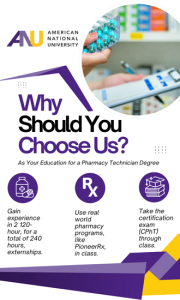
American National University’s pharmacy technician programs are programmatically accredited by the Pharmacy Technician Accrediting Commission (PTAC). Students learn to use PioneerRx, the software used in pharmacies across the country to prepare them for their career. Additionally, students get sent lab kits to do at home under the careful instruction of our professors, like Telicia Ward-Thomas, who just was awarded a 2024 Golden Goggles Student Champion of the Year by Science Interactive for her commitment to her students learning and understanding. Additionally, students must participate in two 120-hour externships, for a total of 240 hours, to gain hands-on experience at a pharmacy local to them. Our associate degree program is designed to make competent, skilled, and capable pharmacy technicians.
While education is not required of a pharmacy technician in all states, it is quickly becoming the norm for many employers.
 The certification and licensure requirements for pharmacy technicians are essential to ensuring quality standards in the field. Although requirements differ by state, certification is widely recognized as a mark of competence, enhancing job prospects and sometimes even necessary for employment. Certification often starts with the Pharmacy Technician Certification Exam (PTCE), administered by the Pharmacy Technician Certification Board (PTCB). To be eligible, candidates generally need to complete a PTCB-recognized education program or equivalent work experience. Passing the PTCE demonstrates proficiency in core areas such as pharmacy law, medication safety, and inventory management, which are integral to the pharmacy technician’s role. According to the PTCB, certification needs to be renewed every two years, requiring certified technicians to meet continuing education requirements to stay current with industry standards.
Licensure, distinct from certification, varies by state and may involve passing a state-specific exam. Many states require pharmacy technicians to register with the state’s board of pharmacy, a process that may include background checks and proof of training or certification. Accredited programs, such as those approved by the American Society of Health-System Pharmacists (ASHP), are often favored by employers, as these programs meet high industry standards and prepare students for both certification exams and state licensure, like ANU’s programs are. By the end of our programs, diploma or associate degree, students will take the Certified Pharmacy Technician (CPhT) exam through the Pharmacy Technician Certification Board (PTCB) as part of our Pharmacy Tech Exam Success class.
These certifications and licensure standards help create a consistent level of expertise, which is crucial in a field where precision and safety are paramount. And as the largest generation, the boomer generation, continues to age and need more medical attention, pharmacy technicians being trained and licensed/certified is more important than ever.
The pathway to becoming a pharmacy technician involves meeting essential requirements, from completing foundational education to obtaining certification and licensure. These steps ensure that pharmacy technicians possess the knowledge and skills needed to perform their duties safely and effectively. For those asking, ‘what are the requirements to be a pharmacy technician?’, it’s clear that each stage plays a vital role in preparing for a successful and rewarding career in healthcare. ANU’s programs help prepare you for being in a pharmacy, give you the opportunity to get hands-on training both at home and within a real pharmacy, and prepares you to sit for the CPhT exam so that you can flourish in your future career. To learn more about ANU’s programs, go to an.edu.
American National University – Be live, in class, from anywhere.
